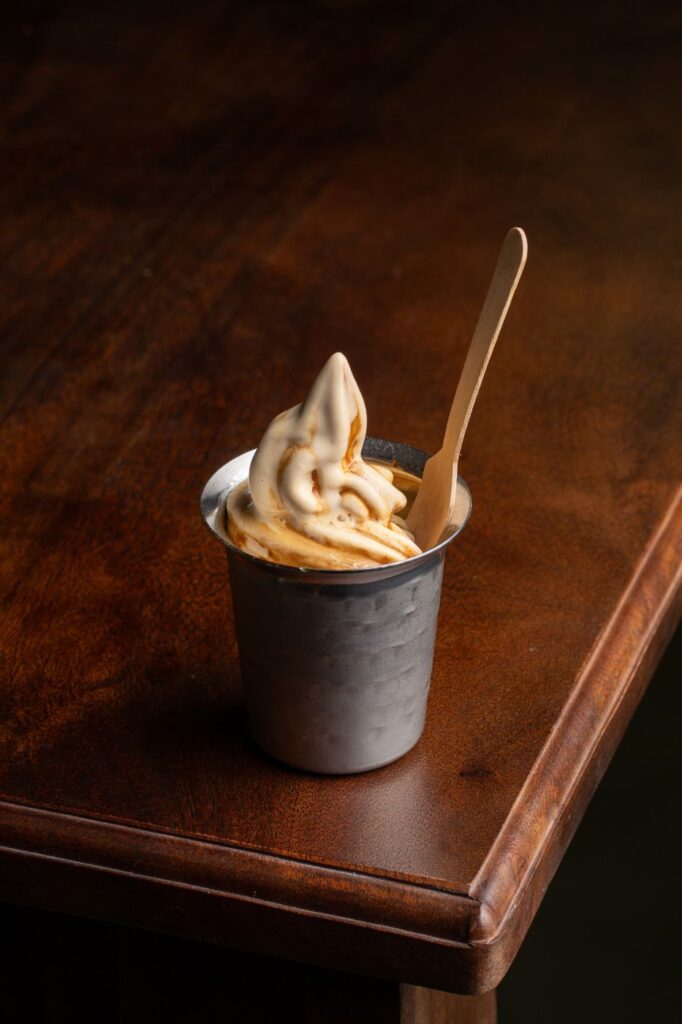
Order a coffee soft serve almost anywhere and you get something sweet with a brown tinge and a vague suggestion of coffee somewhere behind it. We wanted the opposite problem.
Short version: our softy is made from filter coffee decoction rather than coffee flavouring, and that decoction contains chicory. Chicory brings a mild bitterness that pushes back against the sugar, so the coffee stays in front even after it’s frozen.
Cold is the enemy of flavour
Chill anything and you mute its aroma, and aroma is most of what you’re tasting. It’s why a warm soft drink tastes sickly and a cold one tastes fine — same sugar, different perception.
So a frozen coffee has to start louder than a hot one just to arrive at the same place. Use weak coffee and the freezer swallows it whole, leaving you with sweetened dairy. That’s the shortcut most coffee ice cream takes: add more sugar, call it dessert.
What chicory in filter coffee actually does
Chicory in filter coffee is not a modern shortcut. Chicory root, roasted and ground, has been part of South Indian coffee for generations. It has no caffeine. What it has is body, a very dark colour, and a bitterness that is gentler than coffee’s own but more persistent.
In a hot cup it stops the milk from flattening everything. Frozen, it does the same job against sugar. The sweetness arrives, and then chicory turns up and stops it becoming the whole story. What’s left at the end of a spoonful is coffee.

Made from the same decoction as the hot cup
There’s no separate coffee syrup and no instant powder. The decoction that goes into the softy is the one dripping through the filter for the kaapi — strong enough that a small measure makes an entire cup when it meets boiling milk.
Which means if you like our hot kaapi, you already know how the softy is going to taste. It is the same drink, sitting down.
Served in a steel tumbler, and not for the aesthetic
Well — partly for the aesthetic. But steel also gets cold fast and stays cold in your hand far longer than a paper cup manages in a Pune afternoon, and it makes the point that this is the coffee, not a dessert that happens to be nearby.
When to order one
- Three in the afternoon, when a hot cup feels like too much but you still want the coffee.
- After a dosa, instead of dessert. It’s lighter than it looks.
- With someone who says they don’t drink coffee. They’ll eat this. Every time.
It’s in the brew section of the menu. There’s also a longer piece on what a kaapi softy actually is, and if you want to compare it against everything else in the coffee world, we did that in filter kaapi vs cappuccino vs cold brew. Photos on @benneandbrew.
See the menu · Get directions · Call +91 94033 32769 · Book a table
Frequently asked questions
What is chicory in coffee?
Chicory is a root, roasted and ground, that has been blended into South Indian coffee for generations. It adds body, deep colour and a mild bitterness of its own. It contains no caffeine, so it deepens flavour without adding to the dose.
Does the kaapi softy have real coffee in it?
Yes — it is made with the same filter decoction used for the hot kaapi, rather than coffee flavouring or instant powder. That is the only reason it still tastes of coffee once it is frozen.
Why does frozen coffee usually taste weak?
Cold suppresses aroma, and most of what we read as flavour is aroma. Anything served frozen needs to be built stronger than it would be served hot, which is why weak coffee ice cream ends up leaning on sugar.