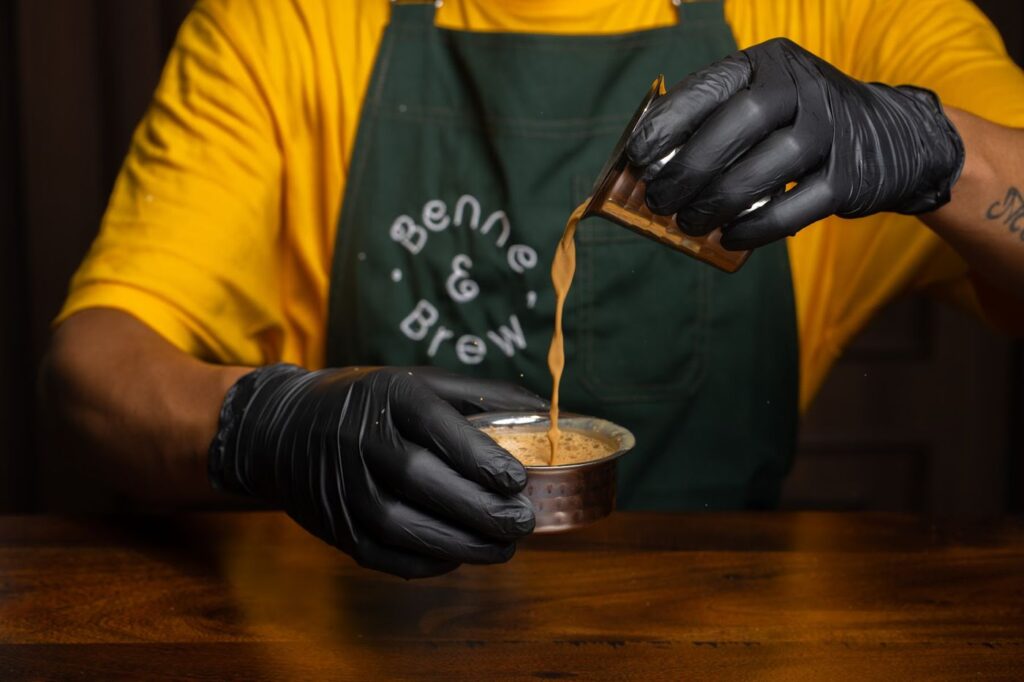
Filter kaapi vs cappuccino vs cold brew: all three are coffee. Beyond that they have almost nothing in common — different water temperatures, different timescales, different reasons for existing. Worth knowing which one you actually want.
Short version: filter kaapi is a concentrated decoction dripped slowly through coffee and chicory, then mixed with hot milk and served small and strong. A cappuccino is espresso pushed through under pressure in thirty seconds, then topped with foamed milk. Cold brew steeps coffee in cold water for hours, which makes it smooth and low in acidity.
Filter kaapi: slow, hot, concentrated
Ground coffee and chicory go into a steel filter, hot water goes on top, and gravity does the rest. Twenty minutes later — sometimes longer — you have a thick, dark decoction. A small measure of it plus boiling milk makes a cup.
Then it’s pulled between the dabara and the tumbler from a height, which cools it to drinking temperature and puts a head of froth on it. The showmanship is real but it’s also functional.
Tastes like: strong, slightly bitter, sweet with milk, unmistakably itself.
Cappuccino: fast, pressurised, foamy
An espresso machine forces hot water through finely ground coffee under pressure for about thirty seconds. That’s the shot. Steamed and foamed milk goes on top in roughly equal parts.
Everything about it is quick and machine-dependent. The upside is control and consistency; the downside is that you’re at the mercy of the machine, the grind and whoever is operating both.
Tastes like: milk-forward, softer, with whatever the beans were doing coming through in the aroma.
Cold brew: long, cold, smooth
Coarse grounds sit in cold water for twelve hours or more, then get filtered out. Cold water extracts fewer of the acidic compounds that hot water pulls, so it tastes rounder and less sharp. Often served over ice, sometimes diluted.
Tastes like: smooth, low-acid, faintly sweet, less of the bite you’d expect from something this strong.
Filter kaapi vs cappuccino vs cold brew, side by side
| Filter kaapi | Cappuccino | Cold brew | |
|---|---|---|---|
| Brew time | ~20 minutes, hot drip | ~30 seconds, pressure | 12+ hours, cold steep |
| Serve size | Small tumbler | Cup, milk-heavy | Tall, over ice |
| Taste | Strong, chicory depth | Milky, soft | Smooth, low acid |
| Best for | A reset, any time of day | Sitting with it a while | Hot afternoons |
| Equipment | A steel filter | A machine and a technician | Time and a jar |
Which to order
If you want to be awake and you want it to taste of coffee, filter kaapi. If you want something to hold for half an hour while you talk, a cappuccino. If it’s a Pune afternoon in the high thirties, cold — which for us means iced filter kaapi made from the same decoction, or a kaapi softy if you’d rather eat it than drink it.
We make one of these three all day, and we’re not neutral about it. Come and argue with us — the counter is at Shubh Nirvana in Viman Nagar, and there’s a pour-shot on @benneandbrew.
See the menu · Get directions · Call +91 94033 32769 · Book a table
Frequently asked questions
Is filter coffee stronger than cappuccino?
In taste, usually yes — filter kaapi is made from a concentrated decoction and served in a small tumbler, so each mouthful is intense. In total caffeine, a cappuccino made with a double shot can be comparable; the difference you notice is concentration, not necessarily dose.
What is the difference between filter coffee and cold brew?
Filter kaapi is brewed hot: hot water drips through coffee and chicory over about twenty minutes, producing a thick decoction that is then mixed with hot milk. Cold brew steeps coffee in cold water for many hours, which extracts less acidity and tastes rounder and sweeter.
Why does South Indian filter coffee have chicory?
Roasted chicory root adds body, colour and a slight bitterness, and it stretches the coffee. It began as a practical addition and became part of the flavour people expect — a kaapi made with pure coffee tastes thin to anyone raised on it.