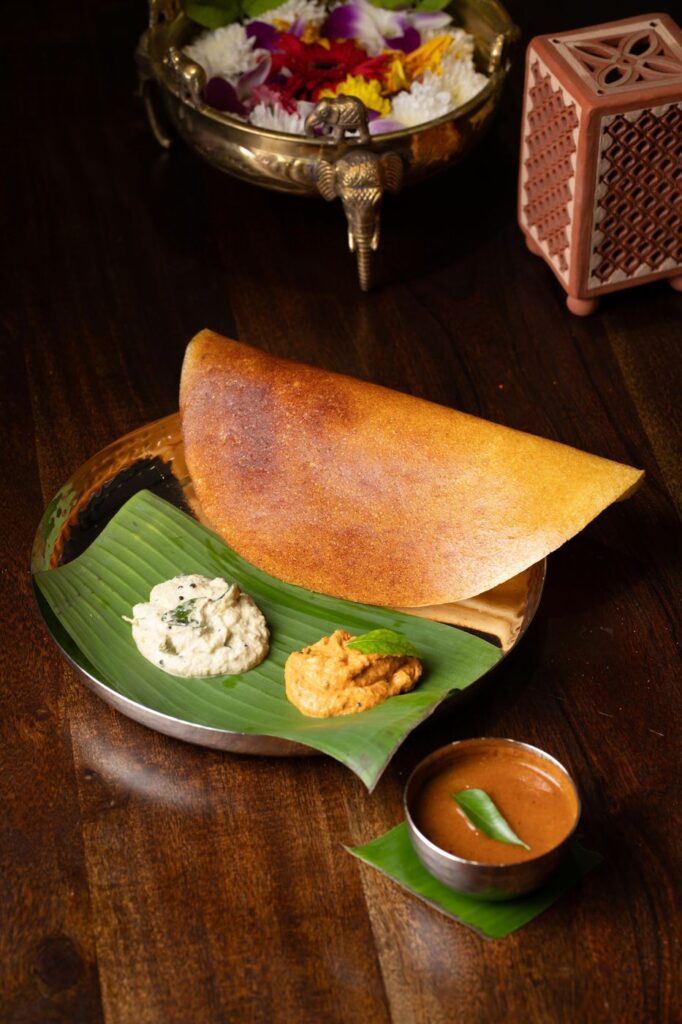
Someone orders a dosa expecting a paper-thin cylinder longer than the plate, and instead gets something thicker, softer and shorter, sitting in butter. Fair enough — here’s what’s going on.
Short version: a benne dosa is the Bengaluru style. The batter is ground to stay tender, spread thicker on the tawa, cooked slower so the base goes deep gold and lacy, and finished with white butter while it is still cooking. You get a crisp bottom and a soft middle instead of uniform crunch.
It starts the day before
Rice and urad dal are soaked, ground and left to ferment overnight. That part is shared with every other dosa in India. The difference is in the grind and the consistency: a benne dosa batter is kept looser and softer, because the aim is not a brittle sheet.
Thicker on the tawa, and slower
Spread a paper dosa thin and cook it hot and fast, and every bit of moisture leaves — that’s why it shatters. Spread a benne dosa thicker and give it time on a moderate tawa, and something different happens: the underside caramelises into a deep gold, lacy from the batter’s own bubbles, while the top stays pale and tender.
Two textures in one bite. That’s the whole idea, and it’s also why rushing it ruins it.
Then the butter, while it’s still cooking
Benne is Kannada for butter. White butter goes on while the dosa is still on the heat, so it melts into the surface instead of sitting on top as a decorative lump. That’s the difference between butter as an ingredient and butter as a garnish.
It’s also why a benne dosa cannot be made “without the butter, please”. You can order a different dosa. This one is defined by it.
What that means for how you eat it
- Eat it now. The crisp base has a window of a few minutes. It does not survive a box, a drive or a long chat.
- Tear from the edge. The rim is the crispest part and the best introduction.
- Don’t drown it. Dip in sambar rather than submerging — the point is the contrast.
- Take the potato palya seriously. In a masala version, the filling is doing half the work.
Where the benne dosa comes from
The benne style belongs to the tiffin rooms of Bengaluru, where a dosa is a short, thick, buttery thing eaten standing up with a small steel tumbler of coffee. Bringing it to Viman Nagar more or less unchanged was the point of opening, which we wrote about in our story.
If you’ve only had the thin kind, order the benne masala dosa once and judge it on its own terms rather than against a different dish. It’s at the tiffin counter, and there’s a close-up or ten on @benneandbrew.
See the menu · Get directions · Call +91 94033 32769 · Book a table
Frequently asked questions
What is a benne dosa?
A benne dosa is a Bengaluru-style dosa: thicker and softer than a paper dosa, cooked slower so the base turns deep gold and lacy, and finished with white butter while it is still on the tawa. Benne is Kannada for butter.
How is benne dosa different from masala dosa?
Masala dosa describes the filling — potato palya folded inside. Benne describes the style — thicker batter, slower cooking, butter on the tawa. A benne masala dosa is both at once, which is what we serve.
Why is my dosa not crispy all over?
A benne dosa is not meant to be. The base crisps while the top stays soft, so you get two textures in one bite. A dosa that is crisp the whole way through is a different dish, cooked thinner and faster.