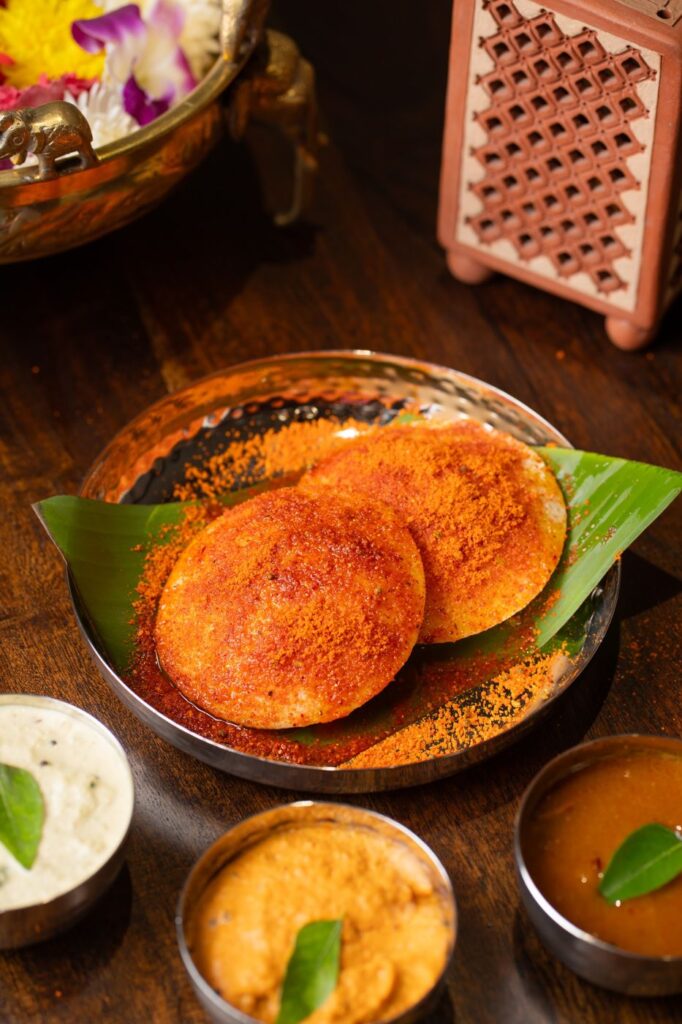
Podi arrives in a small heap beside the chutney. Reddish-brown, slightly coarse, and people either adore it or push it politely to the side of the plate because they have no idea what it is.
Short version: podi (also called gunpowder, or milagai podi) is a dry powder of roasted lentils, dried chilli, sesame and asafoetida, ground coarse. It is eaten mixed with ghee or sesame oil, never dry. “Gunpowder” is a nickname for the colour and texture, not a warning about the heat.
So what is podi, exactly?
So what is podi? The base is roasted lentils, usually urad dal and chana dal. Those are what make it nutty rather than merely hot. Then dried red chilli for colour and bite, sesame seeds for oiliness, asafoetida for that savoury depth that is hard to name, curry leaves, salt.
Everything is roasted separately, because everything browns at a different speed, then ground together coarse. Grind it too fine and it turns to paste in your mouth; leave it too coarse and it does not stick to the idli. Somewhere in between is the whole craft.
The ghee is not optional
Eating podi dry is a mistake you make exactly once. It is a powder; it goes straight to the back of your throat and you cough for a minute while everyone watches.
Mixed with ghee — or sesame oil, which is the older habit in many homes — it turns into a loose, glossy paste that clings to whatever you dip in it. That is the form it is meant to be eaten in.
Where you’ll meet it
- Podi idli — idli cut into pieces and tossed through podi and ghee until every side is coated. Drier than idli sambar, and the easiest South Indian breakfast to eat with one hand.
- Beside a dosa — for dipping, alongside the chutneys.
- Podi dosa — sprinkled across the dosa on the tawa before it’s folded, in some kitchens.
- With rice and ghee — the home version, and the reason many South Indian households never run out of it.
Every family’s podi is different
Podi has no single recipe. Proportions shift by household, by region and by who is grinding. Some are chilli-forward, some are almost sweet with sesame, some carry a heavy hit of asafoetida. People are genuinely loyal to the one they grew up with, and will tell you so.
If you have only ever had podi from a packet, a freshly ground one is a different experience — the roasting is what you are actually tasting, and that fades within a few weeks of being made.
Try it on the idli first
Podi idli is the friendliest introduction: the ghee is already in, the proportions are handled, and you find out quickly whether you’re a podi person. Most people are.
It’s on the tiffin counter. If you want to know what else is on the plate, the breakfast guide covers the lot, and there are photos on @benneandbrew.
See the menu · Get directions · Call +91 94033 32769 · Book a table
Frequently asked questions
What is podi made of?
Podi is a dry powder of roasted lentils — usually urad dal and chana dal — with dried red chilli, sesame seeds, asafoetida, curry leaves and salt, ground coarse. Recipes vary by household and by region, which is why no two taste quite the same.
Why is podi called gunpowder?
The nickname comes from the colour and the coarse, gritty texture rather than from extreme heat. Most podi is warm and nutty rather than fiery, though the chilli ratio is entirely up to whoever ground it.
How do you eat podi?
Mix it with ghee or sesame oil into a loose paste and dip idli or dosa into it. Eaten dry it is harsh and it will make you cough; the fat is not optional, it is part of the dish.