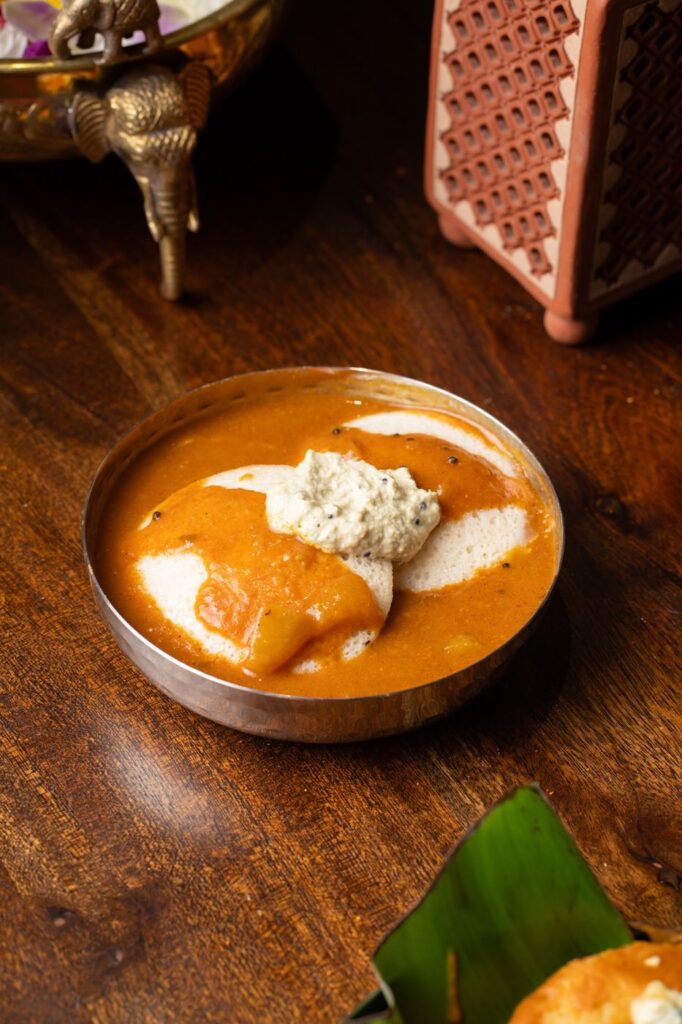
Somebody asks this at the counter roughly once a week, usually while ordering a second round. It deserves a straight answer rather than a health-food answer.
Short version: idli is genuinely light — steamed, not fried, made from a fermented batter that is easier to digest than most breakfast carbs. But “idli” and “a plate of idli the way people actually eat it” are two different things, and the second one involves ghee.
What’s actually in it
Rice and urad dal, soaked, ground, and left overnight to ferment. That’s the whole list. No sugar, no fat, nothing added to make it rise except time and the bacteria already in the air.
Then it’s steamed. Not fried, not griddled, not finished in butter. If you were designing a breakfast carbohydrate from scratch and someone told you it had to be filling but not heavy, you’d land somewhere close to this.
Where the “feels healthy” part comes in
Here’s the honest bit. Almost nobody eats plain idli.
- Ghee goes on podi idli, because podi without ghee is just dust.
- Coconut chutney is coconut. Delicious, not lean.
- The second helping of sambar is the one nobody counts.
- Benne idli is glazed in butter. That is the entire point of it, and we are not going to pretend otherwise.
None of this makes idli unhealthy. It makes it food. The dish is light; the plate is a choice you make at the counter.
The fermentation thing is real, though
The overnight rest isn’t only about the rise. Fermentation starts breaking down starches before the food reaches you, which is why a plate of idli sits lighter than the same quantity of bread. It’s the same reason sourdough tends to be gentler than a regular loaf.
It also explains the faint sourness in good idli. If your idli tastes of nothing at all, the batter was rushed, and you’ve lost both the flavour and the reason it was supposed to be easy on you.
So what do you order?
| If you want… | Order |
|---|---|
| The lightest plate on the menu | Idli sambar, easy on the second helping |
| Light, but with flavour | Podi idli — you control the ghee |
| Not to think about it | Benne idli. It’s butter. It’s wonderful. Move on. |
| To pretend you were sensible | Idli now, filter kaapi after, no softy. We’ll know. |
So, is idli healthy?
So is idli healthy? Yes, with an asterisk. Idli is one of the few genuinely light things you can eat for breakfast that also tastes like something. It is not a diet food, because it was never designed as one — it’s a South Indian staple that happens to be steamed.
Eat it, enjoy it, and don’t lie to yourself about the ghee.
The idlis are at the tiffin counter, and there are more pictures than anyone needs on @benneandbrew. If you want the full tour of what’s on the plate, we wrote a plain guide to South Indian breakfast too.
See the menu · Get directions · Call +91 94033 32769 · Book a table
Frequently asked questions
Is idli good for weight loss?
Idli itself is low in fat, since it is steamed rather than fried, and fermentation makes it easier to digest. What surrounds it decides the rest: ghee, podi, coconut chutney and multiple helpings add up quickly. The dish is light; the meal is up to you.
Is idli better than dosa?
Idli and dosa start from the same fermented rice-and-lentil batter. Idli is steamed, so no cooking fat is involved. A dosa is cooked on a greased tawa and, in the benne style, finished with butter. Idli is the lighter of the two by construction, not by virtue.
Why is fermented food easier to digest?
Fermentation lets natural yeasts and bacteria break down starches before you eat them, which is also what gives idli batter its lift and its faint sourness. It is the same principle behind sourdough bread.